Hardscape Design Ideas for Massachusetts Homes
A plain-English guide from Pineau Landscape Construction in Billerica, MA.
30+ years in the tradeLicensed & insuredOur own crew
Tell Us About Your Project
We follow up directly.
- Family-Runsecond generation
- Our Own Crewno subcontractors
- 30+ Yearsin the trade
- Licensed & Insuredcertificate on request
- Local to BillericaMerrimack Valley
Practical hardscape design ideas suited to New England homes: paver patterns, granite steps, sitting walls, fire features and combined outdoor living.
A good hardscape design starts with how you'll use the yard, then works with what the site gives you: slope, sun, ledge, old trees and New England weather. Here are ideas that hold up in Massachusetts, and why they work.
Start by designing around use
Before you think about materials, list what you want to do outside. Dining for six needs room for a table and for chairs to pull back, which usually means a minimum of 12 by 12 feet. A sitting area around a fire needs room to walk behind seats. A grill needs a landing spot close to the kitchen door. Sketch those zones first, and connect them with paths.
Turn the slope into an asset
Many lots around Billerica, Andover and Lexington have some grade. Rather than fight it, use it.
- Terraces: two levels separated by a low wall can give you a dining patio and a lawn.
- Sitting walls: a low wall at the edge of a patio holds soil and gives you extra seating.
- Granite steps: wide, shallow steps feel generous and suit the region.
Replace the failing deck
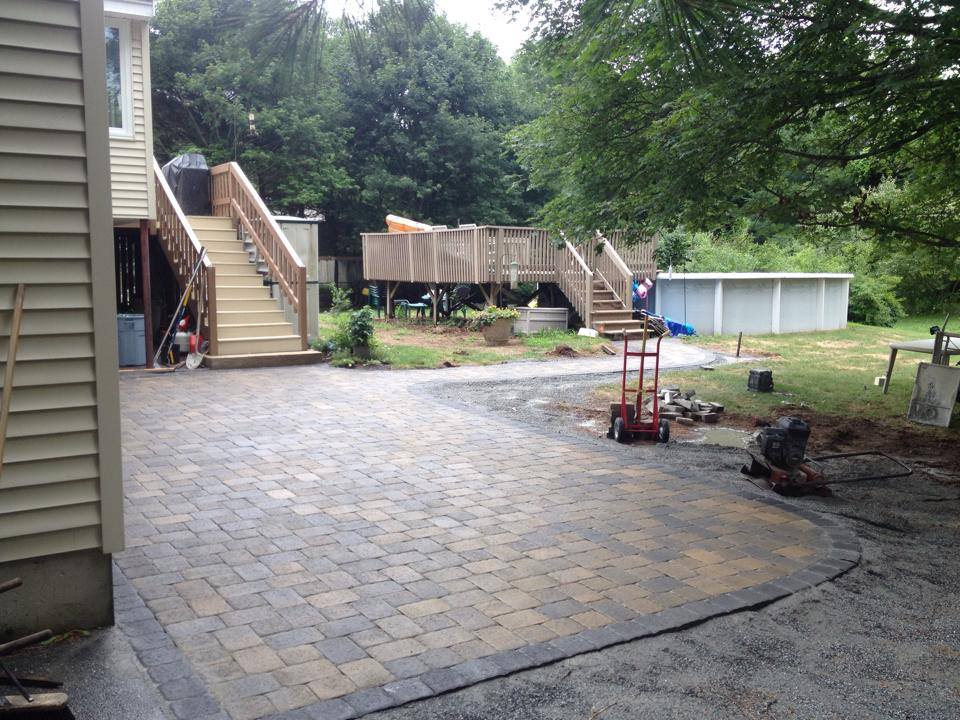
Many older decks are near the end of their life. If the door sits close to grade, a patio with steps can replace a deck entirely. On one Andover project, a failing deck gave way to granite stairs, a paver patio with a circular pattern, a curved sitting wall and a fire pit. If your door sits high, a shorter landing with wide steps down to a patio can work well.
Use local materials
Granite and fieldstone belong here. Granite steps, posts and curbing look right next to a colonial or cape. Old stone walls can be kept, repaired or extended. Pavers in gray and earth tones usually sit well with New England houses and plantings. Try to pull colors from the roof, trim and any stone already on the house.
Curves and circles
A circular pattern set into a rectangular patio gives a space focus without changing the outline. Curved edges soften a square lot and lead the eye around the yard. Keep curves broad and simple. Tight wiggles look fussy and are harder to mow around.
Walkways that make sense
People take the shortest route. Lay out paths along the way they actually walk, and make main walks wide enough for two people, around 4 to 5 feet. Add a landing at the door. Mixing a paver field with a granite border makes a walkway look finished without a large cost.
Fire, water and shade
- Fire pits: a built-in pit extends the season. See our fire pit planning guide.
- Water features: a small pondless feature adds sound with less upkeep than a pond.
- Pergolas: they frame a patio, and they give it a feeling of a room. Compare options in pergola vs gazebo.
Plan for winter
Any hardscape here has to cope with frost, snow and salt.
- Leave a place to shovel snow, so it doesn't end up against the house or on the plants.
- Slope surfaces away from the foundation, and make sure meltwater won't freeze across a step.
- Choose textured surfaces for steps and walks.
- Add low lighting at steps, because the dark comes early in winter.
Don't forget drainage
New hard surfaces change where water goes. A big patio can send water to a foundation or a neighbor if it isn't planned. Think about this at the start, and combine the hardscape with drainage work where it's needed. Our Reading project combined a drainage wall with a patio and stairs.
Plants finish the job
Hardscape looks better softened by planting. Leave planting pockets along walls and beside steps. See our landscape design ideas, and start with our hardscaping services when you're ready.
Questions
How big should a patio be?
Plan from the furniture out. A dining table for six generally needs an area of at least about 12 by 12 feet, and a seating group more.
What hardscape materials suit older New England homes?
Granite, fieldstone and muted pavers usually work well.
Can I keep my old stone wall?
Often, yes. Old walls can usually be repaired or worked into a new design.
Should hardscape come before planting?
Yes. Heavy work should come first, so new plantings are not damaged.
Can I build in stages?
Yes. A master plan lets you build one area at a time, and rough in conduit or drainage early.
Related Pages
Need a Quote?
Pineau Landscape Construction serves Billerica and the surrounding towns. We follow up directly.