Outdoor Fire Pit Planning Guide for Massachusetts Homeowners
A plain-English guide from Pineau Landscape Construction in Billerica, MA.
30+ years in the tradeLicensed & insuredOur own crew
Tell Us About Your Project
We follow up directly.
- Family-Runsecond generation
- Our Own Crewno subcontractors
- 30+ Yearsin the trade
- Licensed & Insuredcertificate on request
- Local to BillericaMerrimack Valley
How to plan a built-in fire pit: placement, material choices, gas vs. wood-burning, and sitting wall design.
A fire pit is one of the most used things you can add to a Massachusetts yard. It extends evenings into the fall, and it gives a patio a focal point. Planning it well takes more than picking a kit. Here is what to think through first.
Start with your town's rules
There is no single statewide fire pit rule that settles every question. Fire departments in Massachusetts generally treat recreational fires differently from open burning, which is regulated by permit and season. Many towns publish their own rules, and they vary on size and distance. For example, Milton defines a recreational fire as no more than 3 feet across and 2 feet high. Upton requires 25 feet from a structure or combustible materials. A State Fire Marshal memo has also pointed to a stricter 75-foot figure for open burning. So call your local fire department before you choose a spot, and ask about wood versus gas.
Choosing the spot
- Well away from the house, decks, sheds, fences, trees and low branches, at whatever distance your town requires.
- On level ground, on a noncombustible surface.
- Where prevailing wind won't send smoke into your windows or your neighbor's.
- With a clear walking route from the house, and enough lighting to see steps at night.
Wood or gas
Wood gives you crackle and heat, with smoke and ash to deal with. Gas starts with a switch and has less smoke. It needs a fuel line or a hidden propane tank, a proper burner system, and licensed trades for the connections. If you might want gas later, consider running a conduit or sleeve before the patio goes down.
Built-in or portable
A built-in pit made of block, stone or granite becomes part of the patio. It lasts, and it looks like it belongs. A portable bowl costs less and can move, but it needs a safe surface and won't anchor the space.
Sizing and seating
- Most residential pits are around 3 to 4 feet across on the outside, subject to your town's limit.
- A seat height of about 18 inches is comfortable, whether chairs or a sitting wall.
- Leave room for people to walk behind the chairs, and to step back from the heat.
- A curved sitting wall can give you built-in seats and hold back a slope at the same time.
Construction details
Good pits are built on a stable base, so frost doesn't crack or tilt them. Wood-burning pits usually need a steel ring or firebrick liner, because ordinary concrete block and some stone can crack or spall under high heat. Drainage matters too: a pit that collects water will hold it, and water that freezes in masonry causes damage. Ask how yours will drain.
Materials that suit New England
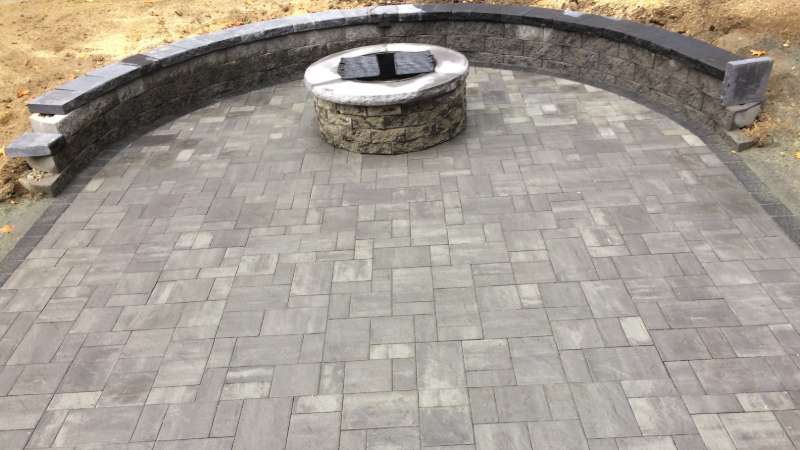
Granite stands up well to freeze and thaw, and it fits the look of the region. Manufactured wall block comes in matching colors for a patio. Our experience with built-in stonework includes a built-in fire pit in Andover, set in a custom paver patio with a curved sitting wall.
What it costs to plan for
The price depends on size, material, whether it is wood or gas, whether a patio exists already, and access. Adding a pit during patio construction is usually simpler than cutting into a finished patio later. Ask for it as a separate line so you can compare options.
Safe use
- Burn clean, dry wood. Towns generally prohibit burning trash, painted wood and construction debris.
- Keep water or an extinguisher close by.
- Never leave a fire unattended, and make sure it's out before you go in.
- Don't use gasoline or similar accelerants to start a fire.
- Check for any burn restrictions during dry, windy weather.
Thinking about one?
See fire pit installation, and tell us what you have in mind. Before you dig, remember Massachusetts requires a Dig Safe ticket at least 72 business hours ahead.
Sources: Town of Milton, Use of Fire Pits; Town of Upton, Outdoor Fire Pit Regulation; Town of Wakefield, Open Burning and Fire Pits; State Fire Marshal memo on open air burning; Massachusetts DPU, About Dig Safe. Rules change and towns differ, so confirm with your local office. This is general information, not legal advice.
Questions
Do I need a permit for a fire pit in Massachusetts?
It varies. Recreational fires are generally treated differently from open burning, but towns set their own conditions. Call your local fire department.
How far should a fire pit be from the house?
Ask your fire department. Published town figures differ, and some are as much as 25 feet or more.
Can I build a fire pit on a paver patio?
Often, yes, with the right base, liner and clearances. It is easiest to plan during construction.
Does a fire pit need a liner?
Wood-burning pits usually do, because high heat can damage ordinary block and some stone.
Is gas or wood better?
Wood gives more heat and atmosphere. Gas is cleaner and easier, but needs a fuel line or tank and proper connections.
Related Pages
Need a Quote?
Pineau Landscape Construction serves Billerica and the surrounding towns. We follow up directly.