Paver Patio vs. Concrete Slab: Which Is Better for New England
A plain-English guide from Pineau Landscape Construction in Billerica, MA.
30+ years in the tradeLicensed & insuredOur own crew
Tell Us About Your Project
We follow up directly.
- Family-Runsecond generation
- Our Own Crewno subcontractors
- 30+ Yearsin the trade
- Licensed & Insuredcertificate on request
- Local to BillericaMerrimack Valley
Comparing paver patios and poured concrete for Massachusetts homes: durability, cost, design and long-term maintenance.
Pavers and poured concrete both make a solid patio. They behave differently in a New England winter, they wear differently over the years, and they cost differently to install and repair. Here is how to decide between them.
The short answer
If budget is the main concern and the design is simple, concrete can make sense. If you want a surface that can move with frost, be repaired piece by piece and be shaped to the yard, pavers usually come out ahead over the long term here.
How each one handles freeze and thaw
Concrete is a rigid slab. As the ground freezes and thaws, the slab can't flex, and it relieves stress by cracking. Control joints direct where cracks will form, but they won't stop them entirely. Deicing salts can also scale the surface of concrete, particularly when it is new.
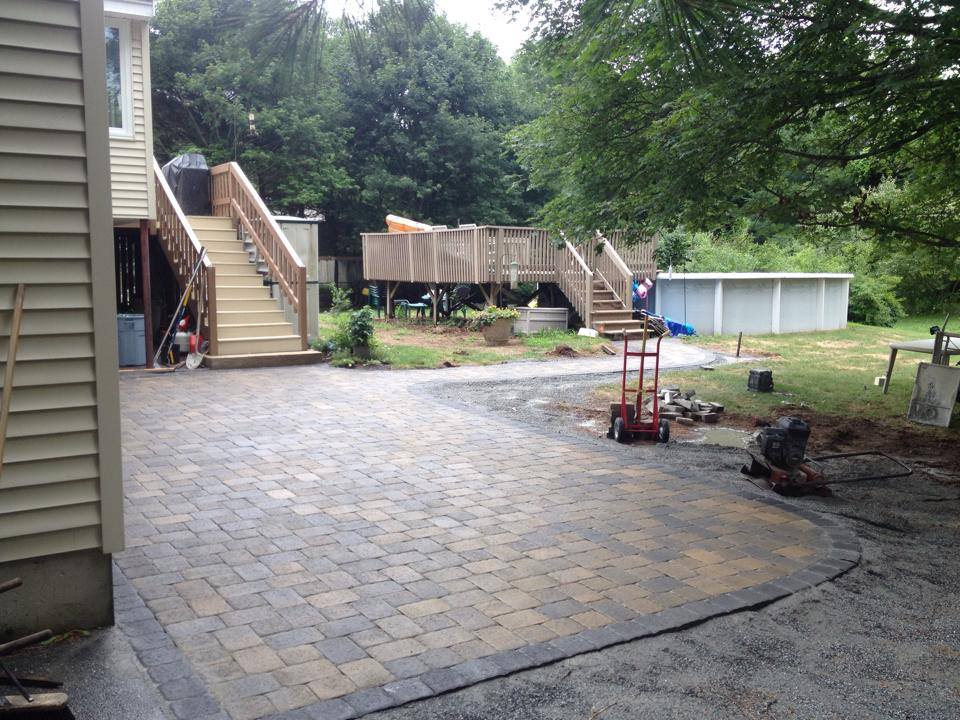
Pavers are small units set over sand and compacted stone. The joints let the surface move a little and settle back. If the base is built right, a paver patio handles frost well. If it is not, you'll see dips and heaving, so the base is what you are really buying.
Looks and design
Pavers come in many shapes, sizes and colors, and they can run in patterns, borders and curves. Stamped concrete can imitate some of that at a lower initial cost, though color can fade and the pattern can look repetitive, and a crack will run straight through it. Plain broom-finished concrete is simple and clean, and it suits some modern homes well.
Maintenance
- Pavers: sweep, top up joint sand when needed, and pull the occasional weed. Sealing is optional. Polymeric joint sand reduces weeds and washout but doesn't last forever.
- Plain concrete: pressure wash now and then, and seal as recommended. Keep rock salt off it, especially in the first winter.
- Stamped concrete: usually needs periodic resealing to hold its color.
Repairs
This is the biggest practical difference. If a paver stains or a section settles, it can be lifted, the base corrected, and the same pavers reset. You can also get under them to reach a utility line. A cracked slab is harder to deal with, and patches rarely match. Replacing a section often means saw cutting and repouring.
Cost over time
Plain concrete usually costs less up front than pavers. Decorative concrete narrows the gap. Over twenty years, what matters is whether the patio has needed major repair or replacement. Get quotes on the same size and scope before deciding, and ask what the base under each option will be. Our paver patio cost guide covers what goes into a price.
Drainage
Either surface needs to slope away from the house. Standard pavers shed most water like concrete does, so don't assume the joints will drain it. Permeable paver systems are a separate product and need a different, open-graded base. If you're building close to a foundation, or the yard already holds water, deal with that first. See our drainage guide.
Which suits which job
- Pavers fit well for: curved patios, sloped yards with walls and steps, areas over utilities, and projects built in phases.
- Concrete fits well for: simple rectangles, tight budgets, and clean modern looks.
- Natural stone is worth a look for: entry walks, stairs and accents. In New England, granite is a natural fit.
What we install
Our hardscape work centers on pavers, granite steps, walls and fire pits. On a recent Andover project the owners replaced a failing deck with a paver patio with a circular pattern, plus granite stairs and a curved sitting wall. See paver patio installation for more.
Sources: ICPI Tech Spec 2, Construction of Interlocking Concrete Pavements; Massachusetts Residential Code, Chapter 3 (frost depth table). Rules change and towns differ, so confirm with your local office. This is general information, not legal advice.
Questions
Are pavers better than concrete in Massachusetts?
For frost movement and repairs, usually yes, provided the base is built properly. Concrete can suit simple, budget-driven projects.
Do pavers heave in winter?
They can if the base is thin, poorly compacted or holding water. A well-drained compacted base is what prevents it.
Will concrete definitely crack?
Most concrete develops some cracking over time. Control joints guide where it happens.
Can I use rock salt on pavers?
Follow the manufacturer's guidance. Clearing snow first and using only what is needed helps protect any surface.
Do pavers need sealing?
Not usually. Sealing can enhance color and limit staining, but it is optional and adds maintenance.
Related Pages
Need a Quote?
Pineau Landscape Construction serves Billerica and the surrounding towns. We follow up directly.