
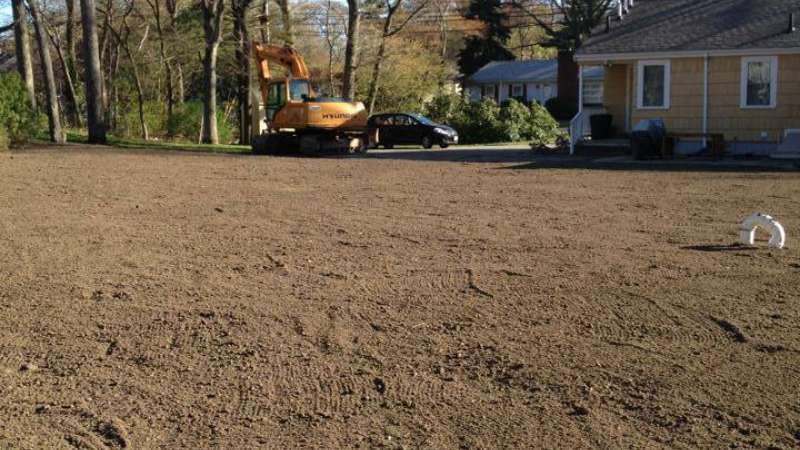
Yard Drainage Solutions: What Works and When
A plain-English guide from Pineau Landscape Construction in Billerica, MA.
30+ years in the tradeLicensed & insuredOur own crew
Tell Us About Your Project
We follow up directly.
- Family-Runsecond generation
- Our Own Crewno subcontractors
- 30+ Yearsin the trade
- Licensed & Insuredcertificate on request
- Local to BillericaMerrimack Valley
A guide to common yard drainage problems: standing water, foundation seepage, French drains, catch basins and dry wells.
Water in the yard is a symptom. Before you pay for any fix, work out where the water comes from, where it wants to go, and what's stopping it. This guide covers the common causes in eastern Massachusetts and which fixes actually work.
Find the source
Go out during a heavy rain, and watch the yard. That is the most useful thing you can do. Look for:
- Downspouts dumping at the foundation
- Water running off a driveway, patio or a neighbor's lot
- Low spots that hold water for a day or more
- Soggy ground long after rain, which suggests a high water table or heavy soil
- Grade that slopes toward the house
- Water seeping out of a slope or from behind a wall
Massachusetts site conditions
Yards around here vary a lot. Some sit on sandy glacial soil that drains quickly. Others have dense till, ledge or fill close to the surface, and water sits on top. Wet areas near brooks and wetlands are common. New houses on old fields can have thin loam over compacted fill. That is why a fix that worked for a neighbor may not work for you.
The main fixes
Downspout extensions
The simplest fix, and often the first step. Carry roof water well away from the foundation, on the surface or through a buried pipe, to a place where it can soak in or drain.
Regrading
The ground beside a house should slope away from it. Soil settles over the years, and regrading can correct that. Keep soil below siding and clear of sills.
Swales
A swale is a shallow, grassed channel that guides water around a house or across a yard. It is simple and doesn't clog like a pipe can. It does need room and a place to go.
French drains
A trench with stone and perforated pipe collects groundwater or soggy-area water, and carries it to an outlet. It needs fall along its length, fabric to keep silt out, and a proper outlet. Many fail because there was nowhere for the water to go.
Dry wells
A buried chamber or stone pit that holds water and lets it soak in. It works in soil that drains. In tight soil or high groundwater, it fills up and sits.
Catch basins and area drains
These pick up surface water in low spots or on paved areas and send it through a solid pipe. They suit patios and driveways that collect water.
Retaining walls with drainage
On a slope, a wall may be part of the fix. On a Reading job where water was reaching the basement, we built a retaining wall with drainage, along with grading and a patio. See our wall types guide.
Know the limits
- Neighbors: Massachusetts applies a reasonable use standard to surface water. You can make reasonable use of your land, but you can be liable if you unreasonably send water onto someone else's. Don't simply move your problem next door. Talk to an attorney if there's a dispute.
- Wetlands: work in a wetland, or in the 100-foot buffer zone, may need review by your conservation commission. Riverfront areas are also protected, generally 200 feet from a river, and 25 feet in some cities including Lowell.
- Utilities: Dig Safe notice of at least 72 business hours is required before excavating, including grading.
- Septic: keep machinery and new drainage away from leach fields, and locate them first.
- Town rules: some towns have stormwater rules for bigger projects. Ask your building or DPW office.
Water in the basement
Start with what's outside: gutters, downspouts and grading. If water still comes in, it may be a groundwater issue. A basement waterproofing contractor or engineer may then need to look at it. A landscaper can do a lot, but not everything. It helps to know which problem you have.
What affects cost
The price depends on the length of the run, depth, access, how far the water must travel, and restoration of lawns or walks. Simple extensions cost little. A long French drain across a finished yard is a real project, and it's worth combining with other work if you can.
Next step
Take a video of the yard during a storm, and send it with your inquiry. It's the best way to show what's happening. See drainage repair and grading and excavating.
Sources: Gillis v. Town of Uxbridge (Mass. App. Ct. 2023), discussing the reasonable use rule; Massachusetts, Protecting Wetlands; Rivers Protection Act Q&A; Massachusetts DPU, About Dig Safe. Rules change and towns differ, so confirm with your local office. This is general information, not legal advice.
Questions
Why is my yard always wet?
Common causes are downspouts, poor grading, heavy soil, or a high water table. Watching the yard during a rain helps pin it down.
Does a French drain always work?
Only if it has enough fall and a proper outlet. Many fail because the water has nowhere to go.
Can I send my water to the street or to my neighbor?
Be careful. Massachusetts uses a reasonable use standard for surface water, and towns may limit discharge to streets. Ask before you build.
Do I need a permit for drainage work?
It depends on scope and location. Near wetlands, talk to your conservation commission first.
Can you fix water coming into my basement?
We can work on grading, walls and yard drainage, which often helps. Some basement water needs a waterproofing specialist.
Related Pages
Need a Quote?
Pineau Landscape Construction serves Billerica and the surrounding towns. We follow up directly.