Types of Retaining Walls: Which Is Right for Your Property
A plain-English guide from Pineau Landscape Construction in Billerica, MA.
30+ years in the tradeLicensed & insuredOur own crew
Tell Us About Your Project
We follow up directly.
- Family-Runsecond generation
- Our Own Crewno subcontractors
- 30+ Yearsin the trade
- Licensed & Insuredcertificate on request
- Local to BillericaMerrimack Valley
Block, natural stone, boulder and timber retaining walls compared: durability, cost, aesthetics and when each type is appropriate.
The right retaining wall depends on what it is holding back, what it will look like from the house, and how much water moves through the site. Here are the main types used in eastern Massachusetts, and where each one fits.
Segmental concrete block
Segmental retaining wall (SRW) block is the most common choice for residential walls. The units are dry stacked, with no mortar, and many systems lock together with lips or pins. Because they aren't mortared, they can tolerate slight movement from frost, and water can pass through.
- Good for: garden walls, terraces, curved walls and sitting walls.
- Watch for: manufacturers generally call for geogrid on walls above about three feet, and each system has its own requirements.
Natural stone, dry laid
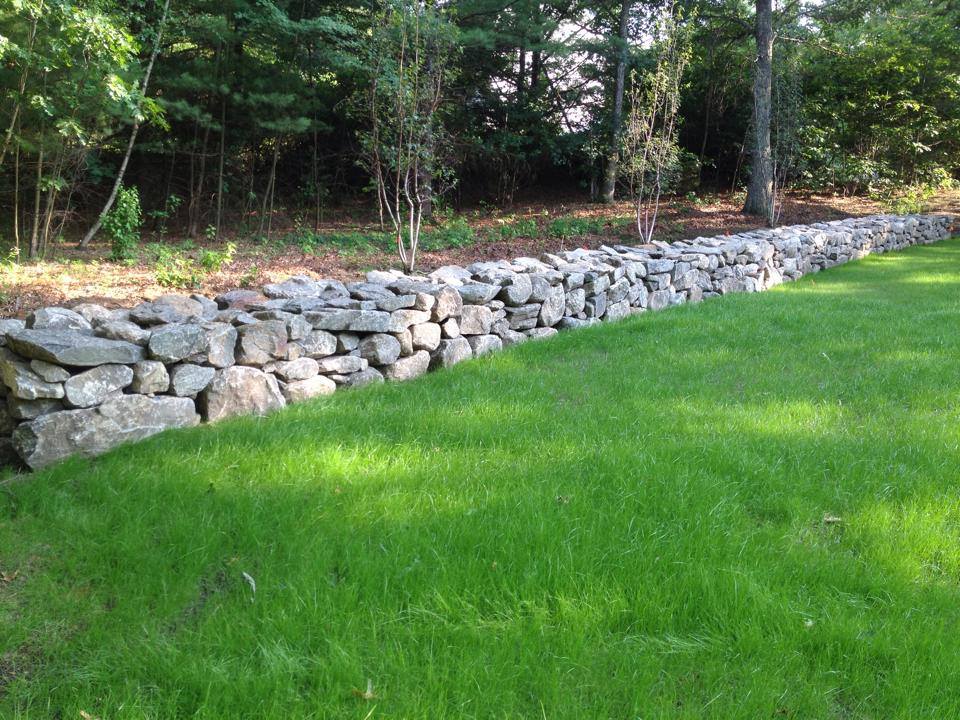
Dry-laid fieldstone walls are part of the New England landscape. A stone wall relies on weight and careful fitting. It drains freely and copes well with frost. Height is limited unless designed, and the skill involved shows in the finished wall.
- Good for: low walls, traditional homes, and historic streets.
- Watch for: stone costs, and the need for a skilled mason.
Granite
Granite blocks, posts and steps are strong and very much at home in Massachusetts. Reclaimed granite curbing can also be used in walls and edging. It is heavy, so it needs machines and access.
- Good for: steps, feature walls and retaining at grade changes near patios.
- Watch for: weight and access, and matching the look of the house.
Boulder walls
Large stones placed by machine give a natural look on steep or wooded slopes. The result is informal, and each wall differs depending on what the quarry supplies.
- Good for: slopes, wooded lots and rugged sites with good access.
- Watch for: a large machine has to get to the site, and gaps need planning.
Poured concrete
A reinforced concrete wall is strong and takes up little space. It usually has a footing below frost depth, which the Massachusetts code puts at 48 inches. It doesn't tolerate movement the way a dry-stacked wall does, so drainage behind it matters a great deal. It can be faced with stone.
- Good for: tight lots, tall walls and structural loads, usually with an engineer's design.
- Watch for: cost, appearance and weep holes or drains.
Timber
Pressure-treated timber walls are the budget option, and many older ones in the area are now rotting and leaning. Timber has a shorter life than stone or block. Replacing an old timber wall is a common project, and it's a good time to fix the drainage too.
What every wall needs
- A proper base: compacted stone for block walls, or a footing for rigid walls.
- Embedment: the first course sits below grade.
- Drainage: free-draining stone behind the wall and a path for water to get out.
- Batter or setback: most walls lean slightly into the slope.
- Compacted backfill: placed in layers, not simply dumped in.
Choosing for your site
- Height: over about 3 feet, plan for reinforcement. Near 4 feet or carrying a load, talk to your building department and possibly an engineer.
- Water: wet slopes favor walls that drain freely.
- Style: match the house. Fieldstone and granite suit older New England homes. Clean block suits newer ones.
- Access: if an excavator can't get in, boulders and large granite become harder.
- Use: a sitting wall needs a comfortable height and a good cap. A wall next to a walkway may need a railing or fence for fall protection.
Where to go from here
Read our retaining wall cost guide, or see retaining wall construction. Our Reading project shows a wall with drainage built as part of a larger fix.
Sources: 780 CMR 105.2, work exempt from permit; Massachusetts Residential Code, Chapter 3 (frost depth table); Nicolock installation FAQs. Rules change and towns differ, so confirm with your local office. This is general information, not legal advice.
Questions
What is the longest-lasting wall type?
Well-built stone, granite, block and reinforced concrete can all last for decades. The base and drainage matter as much as the material.
Are block walls strong enough without mortar?
Yes, when built to the system's requirements. Weight, interlock, base and any reinforcement do the work.
Can a wall be curved?
Yes. Block and natural stone both suit curves. Our Andover project includes a curved sitting wall.
Why are old timber walls failing?
Rot is the usual cause. Timber in contact with wet soil has a limited life.
Does every wall need a drain pipe?
Not every low wall, but every wall needs a way to handle water. Ask how yours will drain.
Related Pages
Need a Quote?
Pineau Landscape Construction serves Billerica and the surrounding towns. We follow up directly.