Paver Patio Cost Guide for Massachusetts Homeowners
A plain-English guide from Pineau Landscape Construction in Billerica, MA.
30+ years in the tradeLicensed & insuredOur own crew
Tell Us About Your Project
We follow up directly.
- Family-Runsecond generation
- Our Own Crewno subcontractors
- 30+ Yearsin the trade
- Licensed & Insuredcertificate on request
- Local to BillericaMerrimack Valley
What affects the cost of a paver patio in Massachusetts: size, materials, base work, steps and site conditions.
You will find plenty of per-square-foot numbers online. We don't publish one here, because the number that matters is the one for your yard, and a figure with no site behind it often sets the wrong budget. What we can do is show you what actually moves the price, so you can read quotes properly and plan a realistic project.
What you are paying for
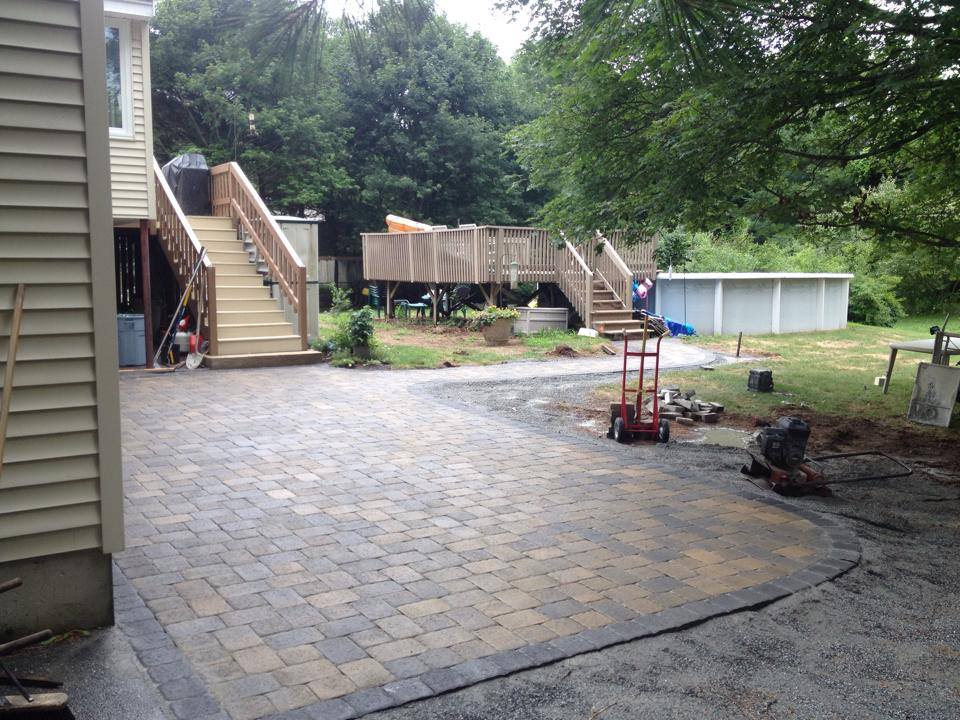
A paver patio is mostly work you never see. The pavers sit on a layer of bedding sand, which sits on compacted crushed stone, which sits on undisturbed or compacted soil. Digging out, hauling off soil, bringing in stone and compacting it in layers takes time and machinery. The paver is often not the biggest part of the job.
The seven biggest cost drivers
- Size and shape: larger patios generally cost less per square foot because setup is spread over more area. Curves and angles mean more cutting and more waste.
- Base work: how much must be excavated and how much stone is needed. Soft, wet or clay-heavy soil adds work.
- Grade: a sloped yard may need a retaining or seat wall, steps or extra fill to create a level surface.
- Materials: standard concrete pavers, tumbled or textured styles, porcelain and natural stone all differ, as do their cutting and laying costs.
- Pattern: running bond is simple. Herringbone, borders and circular accents take longer.
- Access: a machine that can drive to the back yard is one thing. Narrow side gates, fences and steps mean more handwork.
- Add-ons: steps, sitting walls, fire pits, lighting conduit, drainage and removing an old deck or slab.
Why base depth matters here
Massachusetts has a design frost depth of 48 inches, and that figure gets misused. A paver patio is a flexible surface and isn't built down to 48 inches. It is built on a compacted stone base that drains and can move slightly with the ground without cracking. Manufacturer guidance for a patio shows about six inches of compacted stone and an inch of bedding sand. Your site may need more, particularly on wet or silty soil. Geotextile fabric is often used in those conditions. A quote that doesn't state the base is hard to compare with one that does.
What a good quote should list
- Excavation depth, and hauling or disposal of soil
- Base material and finished compacted depth
- Fabric, if used
- Bedding material and joint sand
- Paver brand, style and color
- Edge restraint type
- How water will drain off the patio, and where it goes
- Steps, walls or other features, listed separately
- Lawn repair around the edges and cleanup
- What happens to the yard outside the patio: access routes, spare material and stored stone
- Warranty terms in writing, and how a problem would be handled
Reading two quotes side by side
Suppose two contractors quote the same 400-square-foot patio, and one number is much lower. Before you call it a saving, line them up. Is the excavation depth the same? Is the base the same thickness of the same material? Does one include edge restraint, joint sand and lawn repair while the other doesn't? Is the paver the same product? Is one using its own crew while the other subs out the labor? Often the gap turns out to be scope. When the scope really is the same, you're comparing price, and that's the time to make the decision.
Ways to control the budget
- Simplify the outline. A clean shape with one good curve can look better than a busy one.
- Use a premium paver only for a border or inlay.
- Build in phases. Put in the patio now, and rough in conduit or gas for later.
- Keep the elevation close to existing grade to limit walls and steps.
- Avoid cutting scope on the base. It is the most expensive part to fix later.
Costs people forget
- Dig Safe is free, but the utility marks can change where things go. Massachusetts requires notice at least 72 business hours before digging, including on private property.
- If the patio is near wetlands or a stream, your town's conservation commission may need to review it, which takes time.
- Repairing lawn torn up by access routes.
- Moving irrigation lines or heads.
A real example
On an Andover project, we removed a failing wooden deck and installed granite stairs, a custom paver patio with a decorative circular pattern, a curved sitting wall and a built-in fire pit over three weeks. Removing the deck and adding the steps, wall and fire pit were all part of that scope, so a price for the patio alone wouldn't have told the owners much.
How to get a real number
Call or send us the details. We follow up directly, walk the site and price what's actually there. See our paver patio installation page, or compare materials in pavers vs concrete.
Sources: Massachusetts Residential Code, Chapter 3 (frost depth table); ICPI Tech Spec 2, Construction of Interlocking Concrete Pavements; Nicolock installation FAQs; Massachusetts DPU, About Dig Safe; Massachusetts, Protecting Wetlands. Rules change and towns differ, so confirm with your local office. This is general information, not legal advice.
Questions
Why don't you list a price per square foot?
Because the number depends on your site: base work, access, grade and materials. A generic figure tends to mislead more than it helps.
Does a paver patio need to go down 48 inches?
No. The 48 inches is a frost depth used for structural footings. A paver patio is a flexible surface built on a compacted stone base.
Is a permit needed for a ground-level patio?
Often not, but check with your building department, and with the conservation commission if you are near wetlands. Rules vary by town.
What is the most important thing not to cut?
The base. Pavers can be changed later. A poor base means taking the whole patio up.
Can you build a patio where my deck is?
Often, yes. Our Andover project replaced a failing wooden deck with a patio, steps and a sitting wall.
Related Pages
Need a Quote?
Pineau Landscape Construction serves Billerica and the surrounding towns. We follow up directly.